AI Labeling Requirement 2026: What Advertisers Need to Know by August 2

From 2 August 2026, labeling AI content becomes mandatory. This is not only about big tech. It hits every brand that advertises with AI images, uses synthetic voices in its videos, or runs a chatbot on its website. So almost everyone doing performance marketing today.
Most companies have not seen this coming. Yet the rules are manageable, and if you know them now, you have until August to switch over cleanly. Here is what matters.
What applies from 2 August
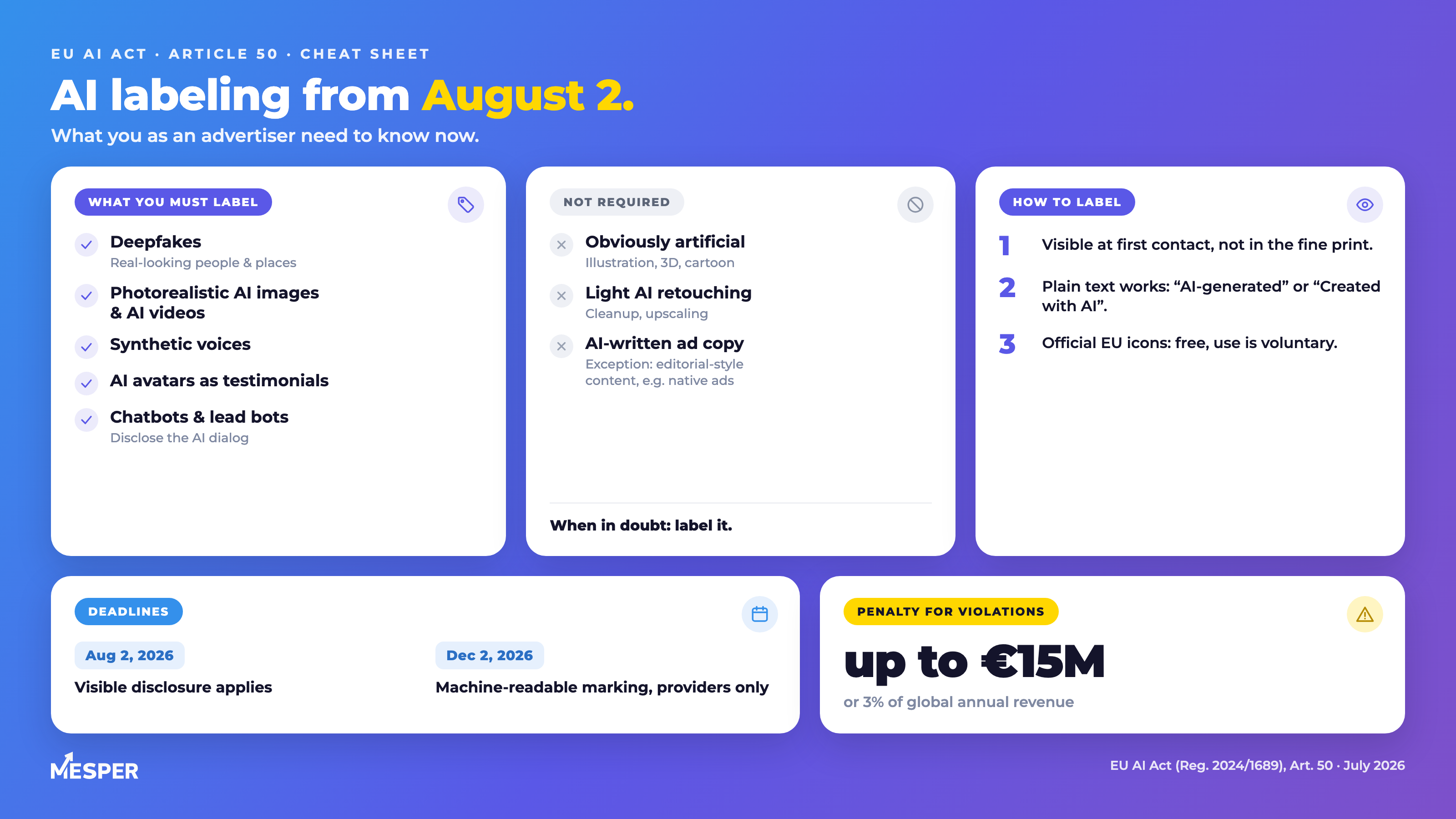
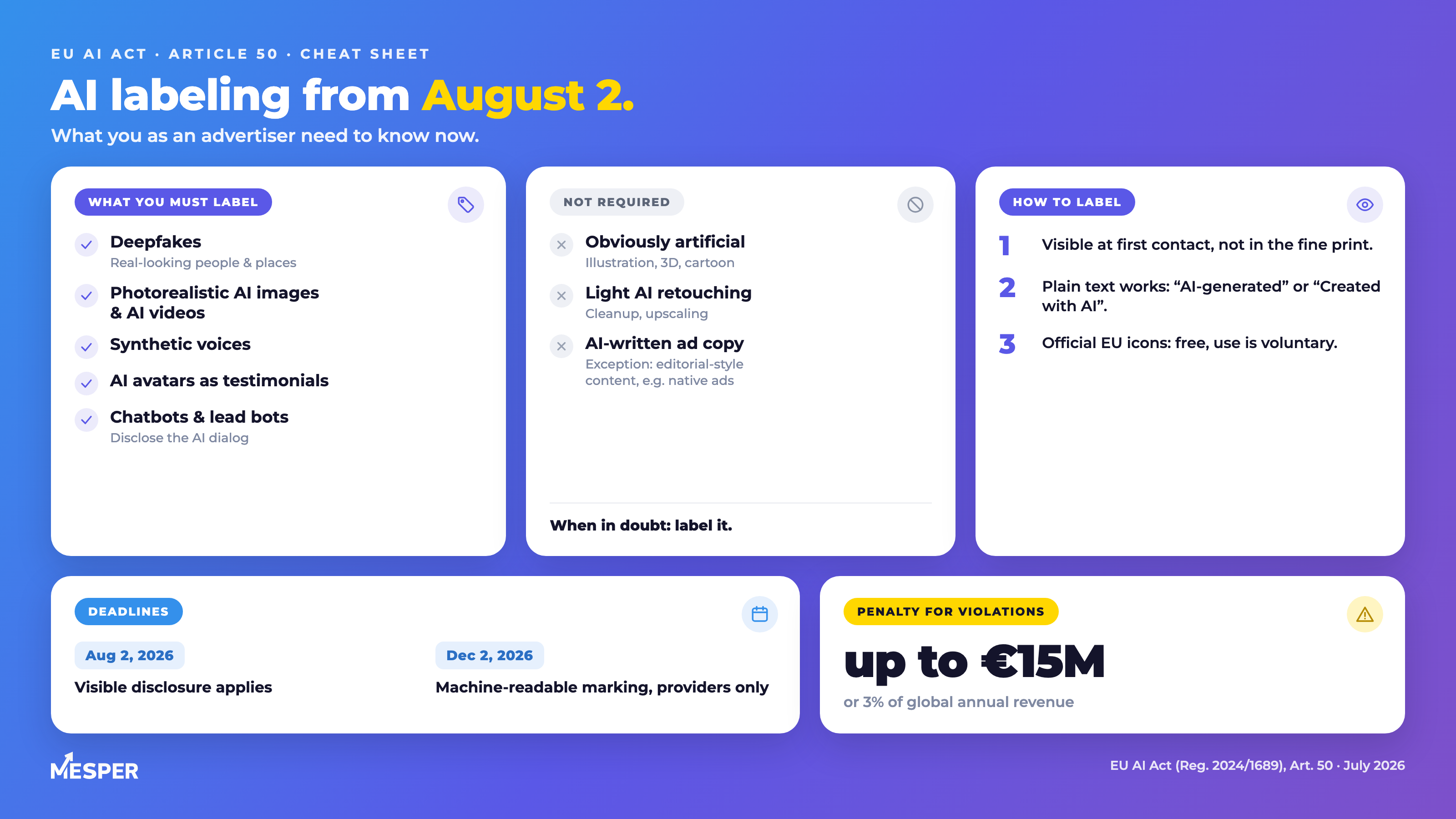
The basis is Article 50 of the EU AI Act, officially Regulation (EU) 2024/1689. The core is simple: people must be able to tell when they are dealing with AI. For you, that means AI-generated images, videos, and voices have to be recognizable as such to the user. And your chatbot has to identify itself as AI instead of pretending a human is on the other end.
What you have to label
- Deepfakes, meaning AI content that shows real-looking people, places, or events
- Photorealistic AI images and videos in your ads
- Synthetic voices and voiceover
- AI avatars that appear as testimonials
- Chatbots and lead bots in customer contact
What you do not have to label
- Obviously artificial content like illustrations, 3D renders, or cartoons
- Light AI retouching like cleanup or upscaling
- Pure AI-written ad copy, with one exception: as soon as the text reads like editorial content, for example a native ad on a health or finance topic, the requirement applies again.
When in doubt, label it. It costs you little and takes the risk off the table.
How to label correctly
The disclosure has to be clear and visible at first contact, not buried in the fine print. A plain-text note is enough, “AI-generated” or “Created with AI”. The EU even provides official icons, free as SVG and PNG. You do not have to use exactly those, they are voluntary. The only obligation is the labeling itself.
The deadlines at a glance
Two dates matter. On 2 August 2026, the visible disclosure to the user applies. The machine-readable marking on the provider side, meaning watermarks and metadata inside the tools themselves, was pushed to 2 December 2026 by the digital omnibus. For you as an advertiser, the first date is the one that counts.
What a violation costs
The fines are not a footnote. Breaching the transparency obligations can cost up to 15 million euros or 3 % of your global annual revenue, whichever is higher. For a growing D2C brand, that is a number you do not want to ignore.
What this means for your ad account
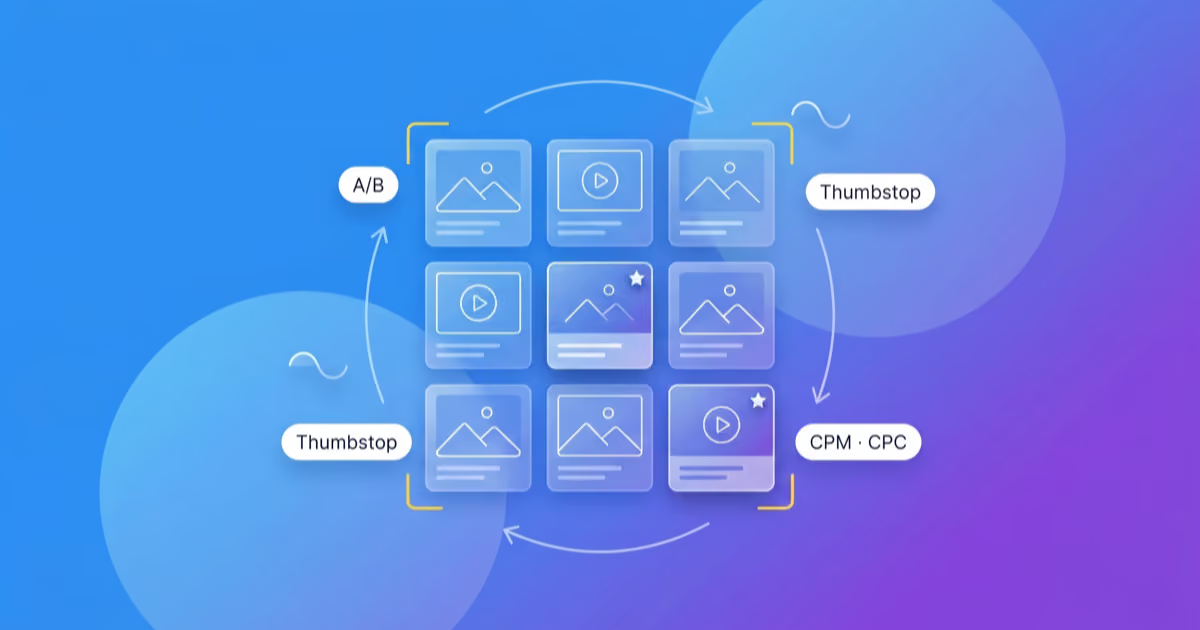
The real question is not whether you label, but how, without your performance dropping. An “AI-generated” note in the wrong spot can kill an ad, in the right spot it costs you nothing. That is the work for the coming weeks: go through your active creatives, mark the ones that need it cleanly, and test which placement of the note holds the numbers.
At Mesper, every AI-assisted creative runs through an approval that thinks about both at once, legal safety and impact. That keeps your account compliant without giving away reach.
Prepare now, not at the last minute
Know the deadline and you can switch over calmly. Miss it and you fix things under pressure in August, while the campaigns are already live.
Want to know which of your content is affected and how to label it without losing performance? Let’s talk for 15 minutes. In a first call we find where your biggest lever is.